The Cathedral in Bangkok That’s Hosted Two Popes
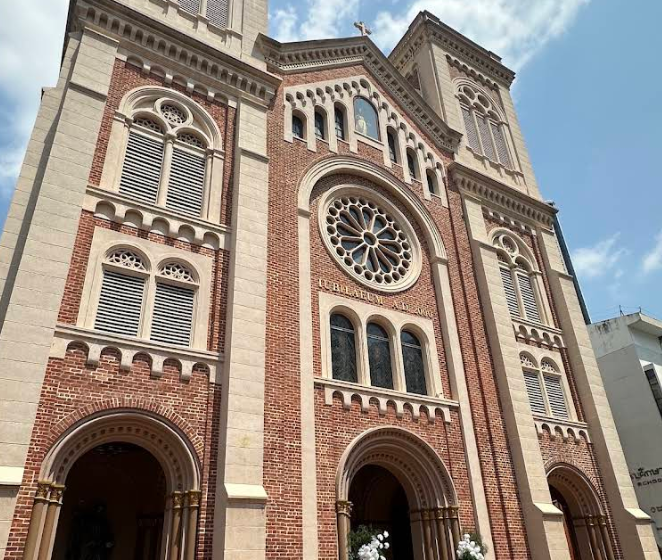
Standing on the banks of the Chao Phraya River in the historic Bang Rak district, Assumption Cathedral is the principal Roman Catholic church of Thailand and the seat of the Archdiocese of Bangkok. With its twin square bell towers, richly coloured brickwork, and a rose window that glows against the tropical sky, it is one of the most photographed religious buildings in the city — and one of the few places in Bangkok where European cathedral architecture stands shoulder to shoulder with luxury riverside hotels and centuries-old trading houses. Locals and visitors alike are often surprised to discover a building of this scale and craftsmanship tucked into a quiet soi just off Charoen Krung Road, a short walk from the Mandarin Oriental Hotel and the French Embassy — institutions that, like the cathedral itself, trace their roots to Bangkok’s earliest days as an international trading port.
Origins: A French Mission on the River
The story of Assumption Cathedral begins in 1809, during the reign of King Rama II, when the French missionary Father Pascal secured land and funding to build a church dedicated to the Assumption of the Virgin Mary. At the time, Bangkok’s Catholic community was small, made up largely of Portuguese and French traders, missionaries, and their Thai converts, clustered along the river that served as the city’s main highway. Construction moved quickly by the standards of the era, and the first church was completed in 1821 — a traditional, relatively modest structure that nonetheless gave Bangkok’s Catholic community its first true home. As the congregation grew through the 19th century, fuelled by continued missionary work and Bangkok’s expansion as a trading hub, the church was formally organised as a parish in 1864, cementing its role not just as a building but as a genuine centre of community life.
Rebuilding a Cathedral: 1909–1919
By the turn of the 20th century, the original church could no longer accommodate its congregation, and in 1909 a major reconstruction began under the direction of a French architect, with Father Colombet serving as rector overseeing the project. The new design called for materials sourced from across the world: brick and labour largely local to Bangkok, marble imported from Carrara in Italy, and stained glass commissioned from French workshops. Remarkably, much of the funding came from a Chinese Catholic businessman, Low Khiok Chiang (also recorded as Jacobe Low Khiok Chianghe), whose generosity allowed the ambitious project to proceed despite its cost. Construction took nine years, and the completed cathedral was consecrated on 15 August 1919 by Bishop René Perros — the building, in its essential form, that still stands today.
World War II proved a serious setback. Bombing raids damaged the cathedral and destroyed its original stained-glass windows entirely. In the decades since, the windows have been painstakingly replaced, once again illustrating scenes from the life of Jesus and core Catholic beliefs, and the building has undergone several rounds of restoration — most notably a substantial renovation in 2013 that refreshed the cathedral’s presence on the Bang Rak riverfront for a new generation of worshippers and visitors.
Inside the Cathedral
Architecturally, Assumption Cathedral blends styles in a way that somehow feels coherent rather than cluttered: a broadly Romanesque exterior with twin towers and rounded arches, layered with Renaissance-influenced detailing and touches that hint at Gothic tradition. The bell tower is said to rise around 32 metres, making it a genuine landmark on the Bang Rak skyline, quite unlike the wats and shophouses that surround it. Step inside and the mood shifts entirely: gilded ceilings dotted with golden stars — a traditional symbol of divine guidance and favour — arch overhead, while frescoes and stucco reliefs tell biblical stories along the walls. The cathedral’s 46 stained-glass windows are its most celebrated feature, each one glowing with colour as sunlight moves through the building over the course of the day, transforming the interior almost hour by hour. Side altars hold statues of saints and scenes from the life of Christ, and bronze statues of Pope John Paul II and Saint Peter stand outside the main entrance, commemorating the pope’s 1984 visit — one of two papal visits the cathedral has hosted, the second being Pope Francis’s visit in 2019.
A Living Community, Not Just a Landmark
Despite Catholics making up only around 1–2% of Thailand’s population, Assumption Cathedral remains a genuinely active parish, not a museum piece. It hosts regular Masses, major celebrations at Christmas and Easter that draw large crowds, and is famously popular as a wedding venue — including, on occasion, for well-known Thai couples, giving the cathedral an unusual crossover into local celebrity culture. The cathedral also sits at the centre of a much larger religious and educational complex, including the Bangkok Catholic Mission, Assumption College, Assumption Convent School, and Assumption University — some of the most respected schools in Thailand — making the site as much an educational landmark as a religious one.
Visiting Assumption Cathedral
The cathedral sits within the Oriental Avenue heritage district, an area that has functioned as one of Bangkok’s key points of contact with the outside world since the 19th century, home to some of the city’s oldest foreign trading houses alongside the Mandarin Oriental Hotel and the French and Portuguese diplomatic missions. That context matters: Assumption Cathedral isn’t an isolated curiosity but part of a wider cluster of heritage buildings that together tell the story of how Bangkok grew from a river town into an international capital. The cathedral is open daily to visitors during daylight hours, and while it remains an active place of worship rather than a museum, respectful visitors are generally welcome to step inside outside of active services to take in the architecture and light. As with any working church, modest dress is appreciated, and visitors are encouraged to be mindful during Mass times or private prayer.
For anyone planning a trip specifically to see the cathedral, pairing the visit with a walk along the riverside promenade near the Oriental Pier, or a stop at one of the historic trading houses nearby, makes for a natural way to spend a morning exploring this often-overlooked corner of old Bangkok.
Quick Facts
Denomination: Roman Catholic (seat of the Archdiocese of Bangkok)
Completed: 1821 (original); rebuilt 1909–1919 in current Romanesque form
Address: 23 Oriental Avenue, Charoen Krung Road, Bang Rak, Bangkok 10500
Phone: 02 234 8556
Nearest BTS/Pier: Saphan Taksin BTS or Oriental Pier (N1)
Access: Via Soi 40, Charoen Krung Road, near the Mandarin Oriental Hotel
Photo credit: http://Google Maps contributor
You may also want to visit: International Churches in Bangkok

[…] You may also want to visit: Assumption Cathedral Bangkok […]