Kalawar: Bangkok’s Hidden Gothic Church by the River
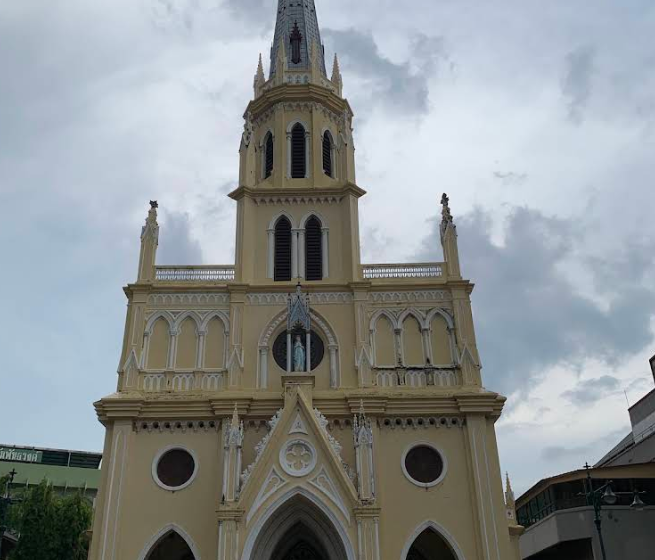
Tucked into Talat Noi, one of Bangkok’s oldest and most atmospheric riverside neighbourhoods, Holy Rosary Church is a cream-coloured Gothic Revival landmark that has watched over the Chao Phraya River for well over a century. Most Bangkokians know it simply as Kalawar Church — a Thai rendering of the Portuguese word Calvario, or Calvary — and its soaring spire has become one of the defining silhouettes of the river, visible to anyone riding the Chao Phraya Express boat past Talat Noi. Sitting between two schools and wedged into a neighbourhood of shophouses, old Chinese mansions, and narrow alleys, the church rewards those who make the short detour off the main tourist trail.
Portuguese Roots After the Fall of Ayutthaya
Holy Rosary’s history stretches back to 1767, when the ancient capital of Ayutthaya fell and its communities scattered. Portuguese Catholics who had lived in Ayutthaya resettled in the new capital area, with one group, led by Father Jacques Corre, settling on the west bank of the river, and another group crossing to the eastern bank around 1786–1787, into what is now Talat Noi. King Rama I, in gratitude for Portuguese assistance during conflicts with Burma, granted this second group land on which to build a church — the origin point of what would become Holy Rosary. Their first structure was a modest wooden building, initially referred to by another name before it took on the identity of Holy Rosary, or Wat Kalawar, that it holds today.
This first wooden church did not last. It was rebuilt in 1838 as the growing congregation outstripped the original structure, and by the late 1880s the church was in poor enough condition that another full reconstruction became necessary. That project, overseen by Father Desalles and completed between 1891 and 1897 at a cost of roughly 77,000 baht — a considerable sum at the time — produced the Gothic Revival building that stands today, the parish’s third structure and by far its most enduring. The church is now officially listed as a cultural heritage artefact by Thailand’s Fine Arts Department, recognition of its place in the city’s architectural and religious history.
A Gothic Landmark on the River
Holy Rosary follows a cruciform floor plan, with its principal façade facing directly onto the Chao Phraya River — a deliberate orientation that lets the building announce itself to anyone travelling by water, as most of Bangkok once did. Its most recognisable feature is a tall, cross-topped Gothic spire, set behind an ornamented gable and flanked by pointed-arch doors and windows in classic Gothic style. Between the main entrance and the spire sits a round window with a statue of the Virgin Mary standing before it, watching out over the river.
Step through the doors and the interior opens into a space painted in soft cream, yellow, and white tones, with golden arches and gilded, curving stucco ceilings that catch the light. At the front of the hall, images of five female saints surround a central figure of the Mother of the Holy Rosary, cradling a child, positioned above the altar. Fourteen paintings depicting the Stations of the Cross line the walls between the windows, and the stained glass itself — widely regarded as among the finest in Thailand — illustrates scenes from the Old and New Testaments in rich, saturated colour. A statue of Christ kept at the church is carried through the surrounding streets during Easter celebrations, a tradition that draws the wider Talat Noi community into the church’s religious calendar even outside regular services.
A Parish Shaped by Migration
Perhaps the most striking part of Holy Rosary’s story is how its congregation has changed over time. As Bangkok’s original Portuguese community gradually dispersed and assimilated, the church might easily have faded — but it found new life through successive waves of migration. Vietnamese and Cambodian Catholics displaced by conflict in Indochina during the 20th century adopted the parish as their spiritual home, and together with a strong Chinese-speaking congregation drawn from the surrounding Talat Noi and Chinatown area, they form much of the parish community that worships there today. This layered history — Portuguese founders, a Thai royal land grant, French-trained clergy, and generations of Southeast Asian migrant worshippers — makes Holy Rosary a uniquely Bangkok story of faith adapting across centuries.
The church’s riverside setting has also made it one of the city’s most sought-after wedding venues, its Gothic arches and golden light providing a dramatic backdrop for ceremonies, while its quiet courtyard offers a genuine moment of calm just steps from the bustle of Chinatown and the modern towers of the Si Phraya waterfront.
Talat Noi: The Neighbourhood Around the Church
Holy Rosary’s setting is as interesting as the building itself. Talat Noi — meaning “little market” — is one of Bangkok’s oldest continuously inhabited neighbourhoods, predating the founding of the city itself and serving historically as Bangkok’s first port of entry for immigrants arriving by river. Portuguese, Chinese, Vietnamese, and Khmer communities have all called the area home at different points, and much of that layered heritage is still visible in its narrow lanes today: the church shares the neighbourhood with the beautifully preserved So Heng Tai Mansion, a roughly 200-year-old Hokkien-style Chinese courtyard house, and sits close to the striking modern headquarters of the Talat Noi branch of Siam Commercial Bank. The area was also the birthplace of Dr. Puey Ungphakorn, a former governor of the Bank of Thailand and one of the most influential Thai public intellectuals of the 20th century, adding another layer of local significance to a neighbourhood that already punches well above its size.
In recent years, Talat Noi has become something of a magnet for photographers and younger visitors drawn to its faded shophouses, street art, and old machine shops, giving Holy Rosary Church a second life as a backdrop for both religious ceremony and casual sightseeing. Visitors arriving by the Chao Phraya Express boat often combine a stop at the church with a wander through the surrounding alleys, making it one of the more rewarding half-day detours for anyone exploring Bangkok’s riverside beyond the more heavily trafficked Chinatown and Wat Pho areas.
Quick Facts
Denomination: Roman Catholic (Archdiocese of Bangkok)
Founded: 1786–87; current building built 1891–1897
Address: 1318 Yotha Road / Soi Wanit 2, Talat Noi, Samphanthawong, Bangkok 10100
Phone: 02 266 4849
Website: rosary.catholic.or.th
Access: Chao Phraya Express boat to Si Phraya Pier (N3) or Marine Department Pier (N4), then a short walk
- Visiting hours — Monday–Saturday: 4:30 PM – 6:00 PM
- Visiting hours — Sunday: 7:00 AM – 11:00 AM and 4:30 PM – 6:00 PM
Photo credit: Google Maps contributer
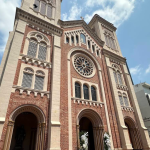
You may also want to visit: Assumption Cathedral Bangkok

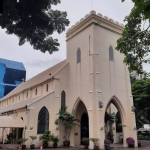
[…] You may also want to visit: Holy Rosary Church Bangkok […]